MR-Consulting:
How a European data standard for the insurance industry is being developed with Enterprise Architect

MR-Consulting and CEN/TC 445 are modelling the future of financial data access in Europe
In future, a European regulation is intended to govern access to cross-border insurance data – an undertaking that goes far beyond a political decision in Brussels. Behind it lies a data model with around 4,500 elements, a semantic process model using BPMN and a technical specification in OpenAPI, all developed with Enterprise Architect from Sparx Systems. At the heart of the project is Dr Manuel Reimer, Chair of CEN/TC 445 and founder of MR-Consulting. Enterprise Architect has supported his work for more than two decades and has proved to be a reliable platform for complex standardisation projects.
A standard for the whole of Europe
With the Financial Data Access (FIDA) Regulation, the European Commission plans to establish a binding framework for how customers and authorised data users can access financial and insurance data. The problem is that no uniform standard for this yet exists in Europe. Countries such as Austria (OMDS), Germany (BIPRO), Belgium (Telebib), the Netherlands (SIVI) and the United Kingdom (Polaris) have their own historically developed solutions – well established, but incompatible. The European Commission has therefore tasked CEN, the European Committee for Standardization, with developing a European standard for customer data access in the insurance industry as part of its work programme. The standardisation project began in February 2025.
The technical committee responsible is CEN/TC 445, “Digital Information Interchange in the Financial Industry”, established in 2016 with its secretariat at the German standards institute DIN. It is chaired by Dr Manuel Reimer, who has been active in German standardisation since 1985 and European standardisation since 1989. For many years, he ran his own software company for insurance brokers and, in 2006, co-founded BIPRO e.V. – the German industry institute for process optimisation in insurance.
Thirteen countries and the two European industry associations BIPAR and Insurance Europe are participating in the project to standardise the customer data interface – a total of 50 experts. The result of these efforts is the European Standard EN 18356-1, “Customer Data Access and Portability in the Insurance Industry – Semantic interface and data model”, together with the associated technical specification CEN/TS 18356-2, which implements the standard as an OpenAPI specification. Publication is planned for 2027.
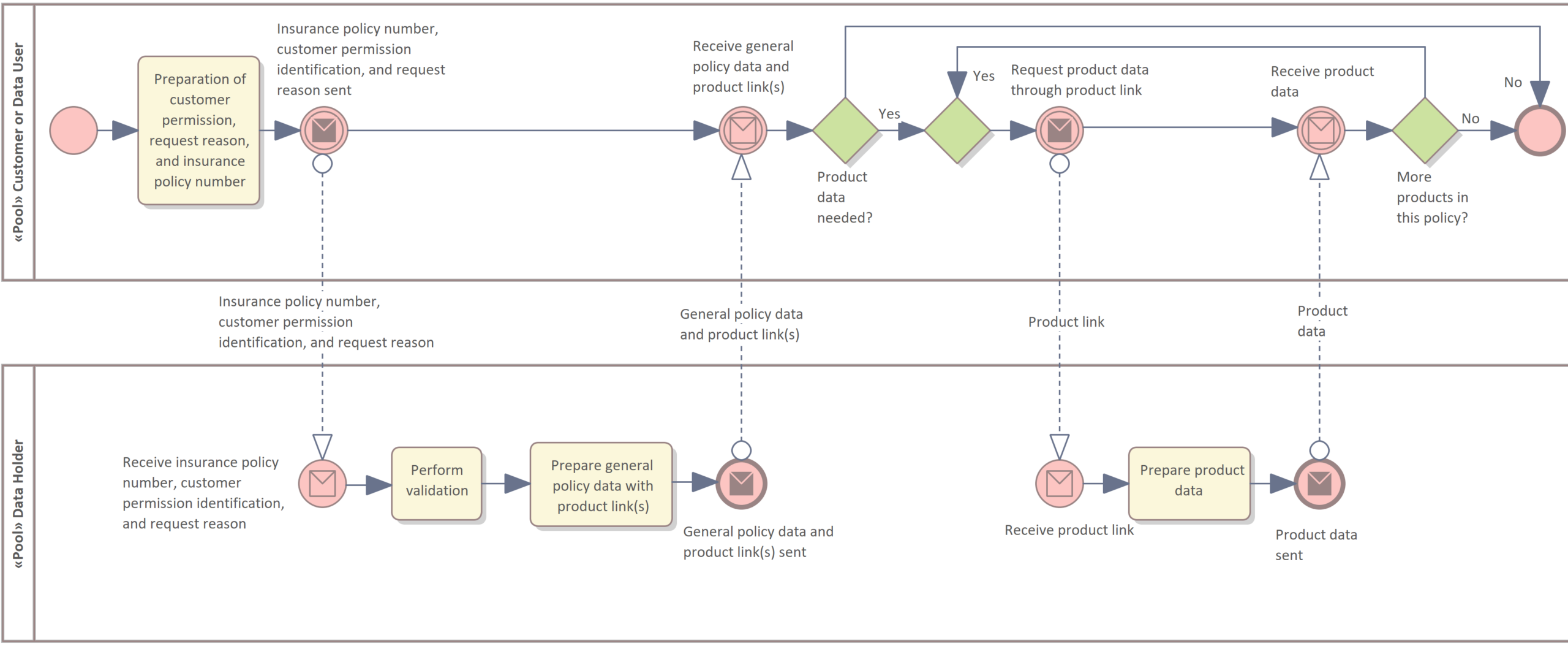
Customer Data Access Process (c) MR-Consulting
The challenge: making complexity visible and manageable
A data model covering every class of insurance – from motor, property and liability insurance to life and pension insurance – along with all the associated processes, roles and data elements is naturally enormous in scope. The model contains more than 400 data elements for motor insurance alone, and considerably more for private and commercial property insurance. In total, the standard comprises around 4,500 data elements. “Our insurance industry is very complex because of the different risks and products specific to each market,” says Dr Reimer. “This complexity cannot be contained in a single text document – it needs a tool that can model processes and data in a structured way, keep them consistent and allow them to be reused in different formats.”
The solution: one model in Enterprise Architect, many output formats
CEN/TC 445 works at two levels, both of which are fully represented in Enterprise Architect. At the business, semantic level, the process model is first created in BPMN – for example, to show the steps involved in a customer enquiry or access by an authorised data user. Alongside this, the business data model is built in UML, describing objects such as insurance policies, contracting parties, products, cover and claims, together with their attributes and relationships.
The team then derives the technical specification from this single model: the technical process flow is implemented as a REST interface and the technical data model as a JSON structure in an OpenAPI specification. In doing so, CEN/TC 445 consistently follows the established principle of standardisation: business semantics first, technical syntax second. “One thing we value greatly is that the data is stored in open formats. This means we can obtain the different representations of our data model – whether as text, Excel tables, graphics or HTML documentation – either directly from Enterprise Architect or generate them ourselves using our own programs and scripts,” explains Dr Reimer.
This open approach also proves its worth in an international standardisation environment: XMI exports allow the models to be shared openly with other organisations and tools. This matters because a standards committee cannot prescribe particular software for users of its standards.
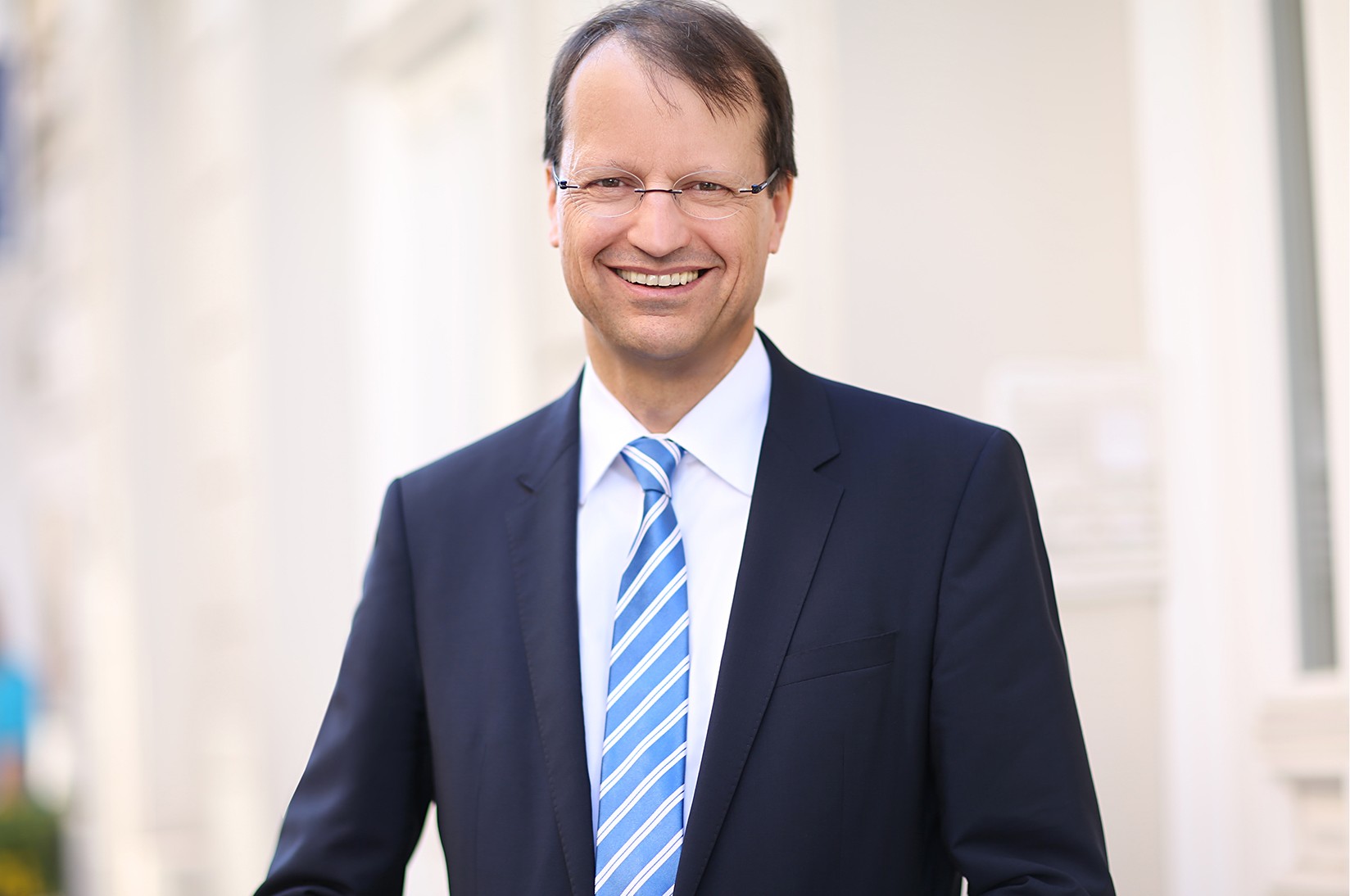
Dr Manuel Reimer, Chair of CEN/TC 445 and founder of MR-Consulting
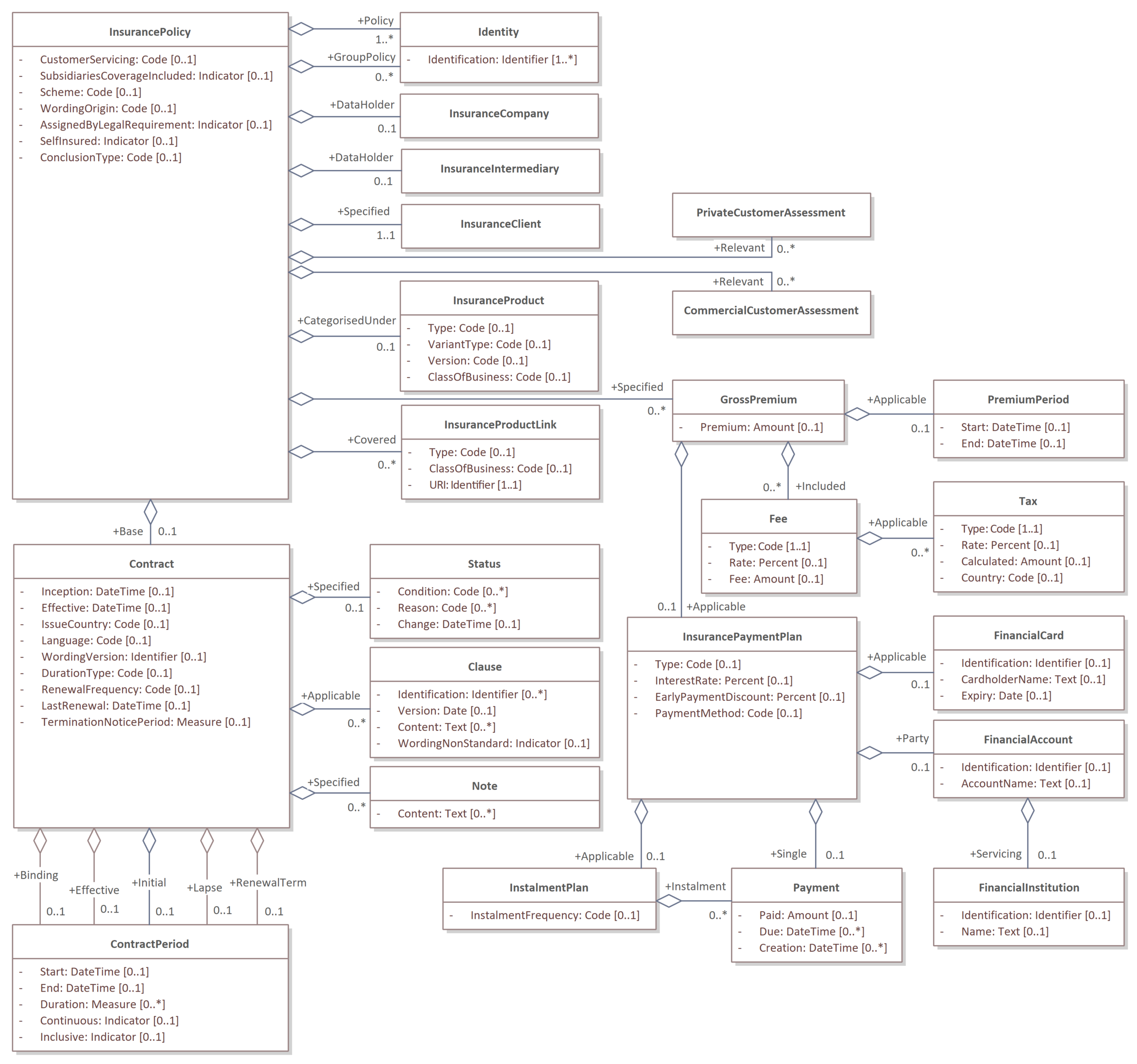
General Insurance Policy (c) MR-Consulting
A pilot project in Latvia shows how well this works in practice. There, the Latvian insurers’ association adopted the European data models, adapted them to national requirements and then automatically converted them into OpenAPI specifications. This provided the basis for a data network between the insurance companies and the association. “The Baltic countries are really very advanced in digitalisation; Estonia and Latvia are leaders in this area,” says Dr Reimer.
Automation not only significantly reduces the maintenance effort; above all, it ensures that the text of the standard, diagrams and technical specification remain consistent at all times – a decisive advantage for a project spanning several countries. “The great advantage is that we do not have to maintain anything twice. When we change the data model, the OpenAPI specification is automatically regenerated and the documentation updated,” explains Dr Reimer. “This avoids transcription errors between the data model and its implementation. With data models containing thousands of elements, which would otherwise have to be painstakingly transferred by hand or copied and pasted from PDF documents, the absence of these errors is one of the most important quality features.”
Two decades of experience as a foundation
MR-Consulting has a long history of using Enterprise Architect. “We have been using Enterprise Architect for many, many years – certainly since the early 2000s,” says Dr Reimer. The decision was no accident, but the result of a deliberate comparison: “In the 1990s, we used a product called Edit from the Netherlands. When it was no longer being developed, we looked at various systems, including IBM’s Rational Rose – and then chose Enterprise Architect because it simply offered the widest range of capabilities, and Sparx Systems was also very committed to standardisation,” Dr Reimer recalls.
The combination of functionality, openness and continuous development was decisive in the choice, he says:
The product has grown alongside our requirements. Sparx Systems has always adapted Enterprise Architect to new technologies. There has never been a reason to question the decision: We value Enterprise Architect highly – also because of the excellent support and continuous development.
Looking ahead
With EN 18356-1 and CEN/TS 18356-2, CEN/TC 445 is laying the foundations for national and cross-border FIDA schemes in the insurance industry. Existing national standards can be linked to the European standard through mapping mechanisms, enabling interoperability between different market solutions. But the journey does not end there: in its Annual Union Work Programme 2026, the European Commission has already identified further standardisation needs in the financial sector under “Action 28” – for example, for credit agreements, financial investments and creditworthiness data. CEN/TC 445 therefore expanded its remit accordingly in summer 2026.
Drawing on his experience of what are now two major European modelling projects, Dr Reimer has a clear recommendation for other standards committees: “What matters is having a tool that supports the entire data modelling process. Only then can you avoid a break in the workflow at some point in the process.”
For Dr Reimer, there is therefore no doubt that future European standardisation projects will also be developed using Enterprise Architect: “We will certainly use Enterprise Architect again for the forthcoming standards in the financial sector. We have the expertise, can continue to develop existing models and have a tool that supports the entire process, from business modelling to the completed OpenAPI specification.”
More information about the CEN/TC 445 project can be found at tc445.info.
About SparxSystems Europe
Sparx Systems Pty Ltd (Australia) was founded in 1996 and is the manufacturer of Enterprise Architect, a globally successful UML modeling platform. Enterprise Architect is used for designing and building software systems, business process modeling and modeling any process or system. Enterprise Architect is valued by over 1 million users for its performance at an unbeatable price. Enterprise Architect is an easy-to-understand, team-oriented modeling environment that helps companies analyse, design and build systems that are accurately understood and documented. With the help of this tool, companies are enabled to collect and present the often very dispersed knowledge of teams and departments centrally.
SparxSystems Software Europe was set up in 2004 to provide the best possible Enterprise Architect service to the many customers in their language and time zone, supporting the entire German-speaking region with license acquisition, training and consulting. SparxSystems Software Europe is a business unit of the Lieber.Group.