
Centers for Medicare & Medicaid Services (CMS):
Reducing service costs through the use of Sparx Systems Enterprise Architecture

Client Overview: Centers for Medicare & Medicaid Services (CMS):
The Centers for Medicare & Medicaid Services (CMS), a key federal agency within the US Department of Health and Human Services, administers healthcare programmes for millions of Americans.
The complexity and scale of CMS’s IT environment presented significant challenges, including a decentralised architecture, disparate data sources and difficulties in aligning business and technical objectives for strategic decision-making. This transformation not only increased efficiency but also led to significant cost savings, ultimately benefiting the agency and the millions of Americans it serves.
This case study examines in detail how CMS used Sparx Systems Enterprise Architect (EA) to establish a centralised, data-driven enterprise architecture platform.
About the video: Senior Solution Architect Christine and her team of experts discuss how they tackled CMS’s business challenges using Sparx Systems’ tools.
Enterprise Architecture Use Cases for CMS
Assessing the impact of healthcare legislation on business and IT operations at CMS
A solution enabling CMS to assess the impact of healthcare legislation on both business and IT operations.
Enabling real-time IT asset management (system inventory)
The platform must support real-time IT asset management and provide a comprehensive and up-to-date inventory of all systems within CMS. This centralised system inventory improves visibility of the IT landscape and enables more effective management and optimisation of IT resources.
Provision of Business Architecture Services
Support in the provision of enterprise architecture services to align business objectives with IT capabilities. By establishing a clear framework for the organisation’s structure, processes and systems, CMS can ensure that its business strategies are effectively
supported by the IT infrastructure.
Facilitating Capital Planning and Investment Control (CPIC)
The platform supports capital planning and investment control, ensuring that all IT investments are strategically aligned with the organisation’s objectives. Sparx Systems EA provides tools for evaluating and prioritising IT projects, optimising resource
allocation and maximising return on investment.
Supporting Governance Bodies in Decision-Making
Sparx Systems EA supports governance bodies through comprehensive data visualisations and reports. These insights enable governance teams to make informed decisions, thereby improving the overall strategic management of IT resources and
ensuring alignment with business objectives.
Reporting to Federal Authorities and Data Requirements
The platform simplifies reporting to federal authorities and compliance with data requirements, ensuring that CMS efficiently meets all reporting obligations. Sparx Systems EA integrates data from various sources and provides accurate and timely
information to fulfil reporting obligations to federal authorities.
Challenges and Drivers of Change
CMS faced several critical issues within its IT architecture:
- Decentralised Architecture: Each department within CMS managed its own IT infrastructure, leading to inconsistencies and inefficiencies.
- Disparate Data Sources: Data was scattered across different systems, making it difficult to gain a comprehensive overview of the IT environment.
- Balancing Business and Technology: Aligning business objectives with technical requirements was a cumbersome process that hindered effective decision-making.
- Reporting Requirements: Meeting the strict reporting obligations of the Ministry of Health and Social Care posed a challenge.
These constraints hampered CMS’s ability to achieve optimal efficiency and transparency in its IT operations, necessitating a transition to a centralised, data-driven architecture.
Sparx Systems EA: A Solution for Centralised Architecture
Strategic Use Cases for CMS EA
CMS has chosen Sparx Systems EA as its enterprise architecture platform to address various strategic use cases:
By implementing these strategic use cases, Sparx Systems EA has transformed CMS’s enterprise architecture, thereby improving efficiency, transparency and decisionmaking capabilities across the organisation.
Durch die Umsetzung dieser strategischen Anwendungsfälle hat Sparx Systems EA die Unternehmensarchitektur von CMS transformiert und damit die Effizienz, Transparenz und Entscheidungsfähigkeit im gesamten Unternehmen verbessert.
CMS Enterprise Data Analytics Repository (CEDAR)
At the heart of the new architecture is a cloud-based environment called ‘CEDAR’, which integrates several key components:
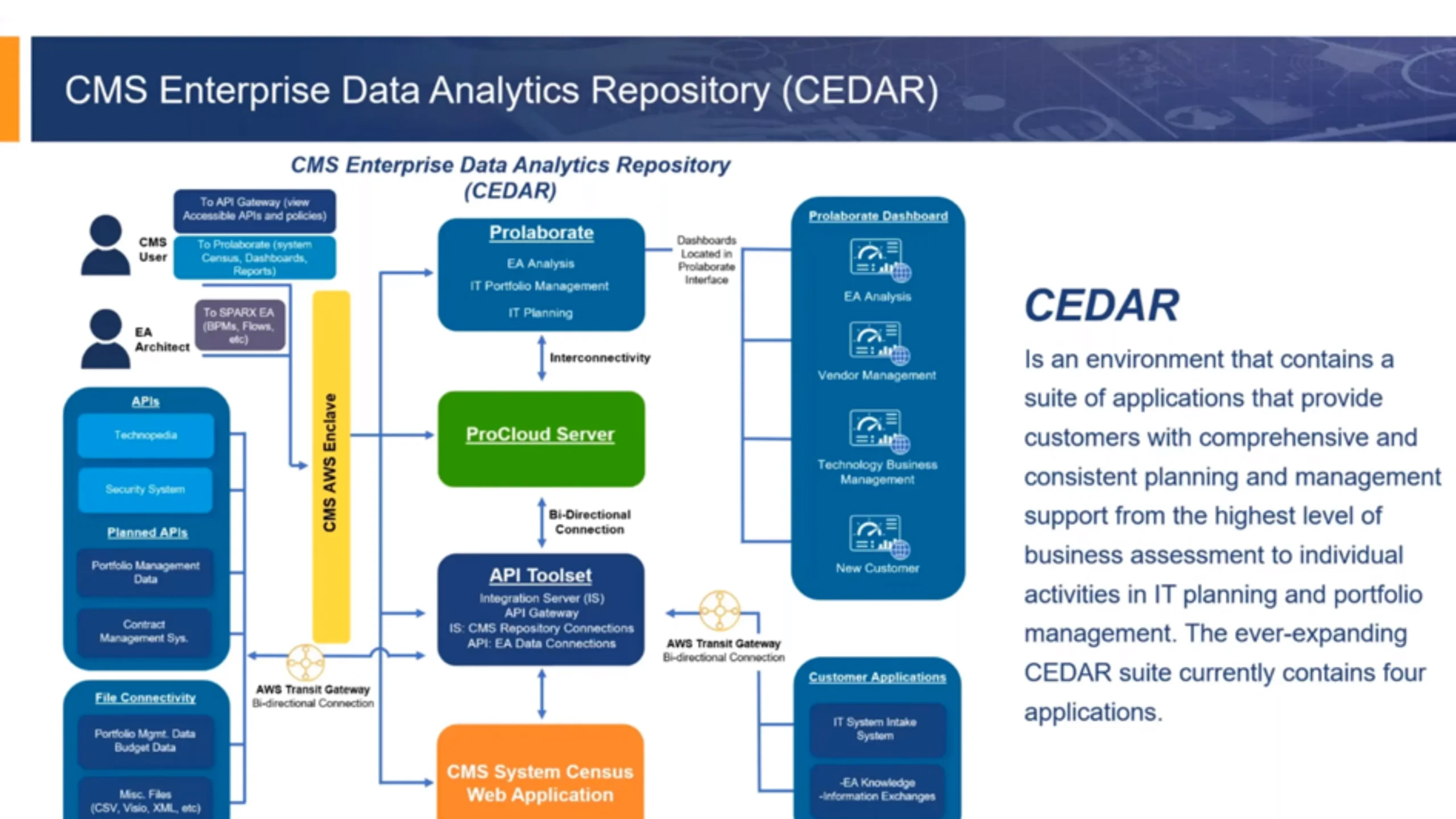
- Sparx Systems Enterprise Architect: The core platform for modelling enterprise architectures.
- Sparx Systems Prolaborate: A collaborative workspace where stakeholders can access and share architectural information.
- Pro Cloud Server: Enables the secure deployment of Sparx Systems EA and Prolaborate in the cloud.
- API-Tools: Facilitate data integration between Sparx Systems EA and external systems.
- Web Application: Provides a user-friendly interface for accessing and interacting with architecture data.
Implementation Process: CMS Enterprise Architecture and Tool Migration Journey
In June 2021, the Centers for Medicare & Medicaid Services (CMS) embarked on a significant journey to address the challenges arising from its existing enterprise architecture (EA) toolset and methodology.
Recognising the need for a more efficient, coherent and data-driven approach, CMS initiated the migration to a new EA tool. This approach to migrating the EA tool was carefully planned and implemented in four main phases.
In phase one, a comprehensive EA baseline assessment was carried out to capture the current state. Phase two focused on documenting the EA and tool requirements to ensure that all stakeholders’ needs were taken into account. Phase three involved a thorough evaluation of potential tools to identify the one best suited to the CMS’s requirements. Finally, phase four saw the implementation of the selected tool and the new methodology, thereby realising the vision of a centralised, efficient and innovative EA platform.
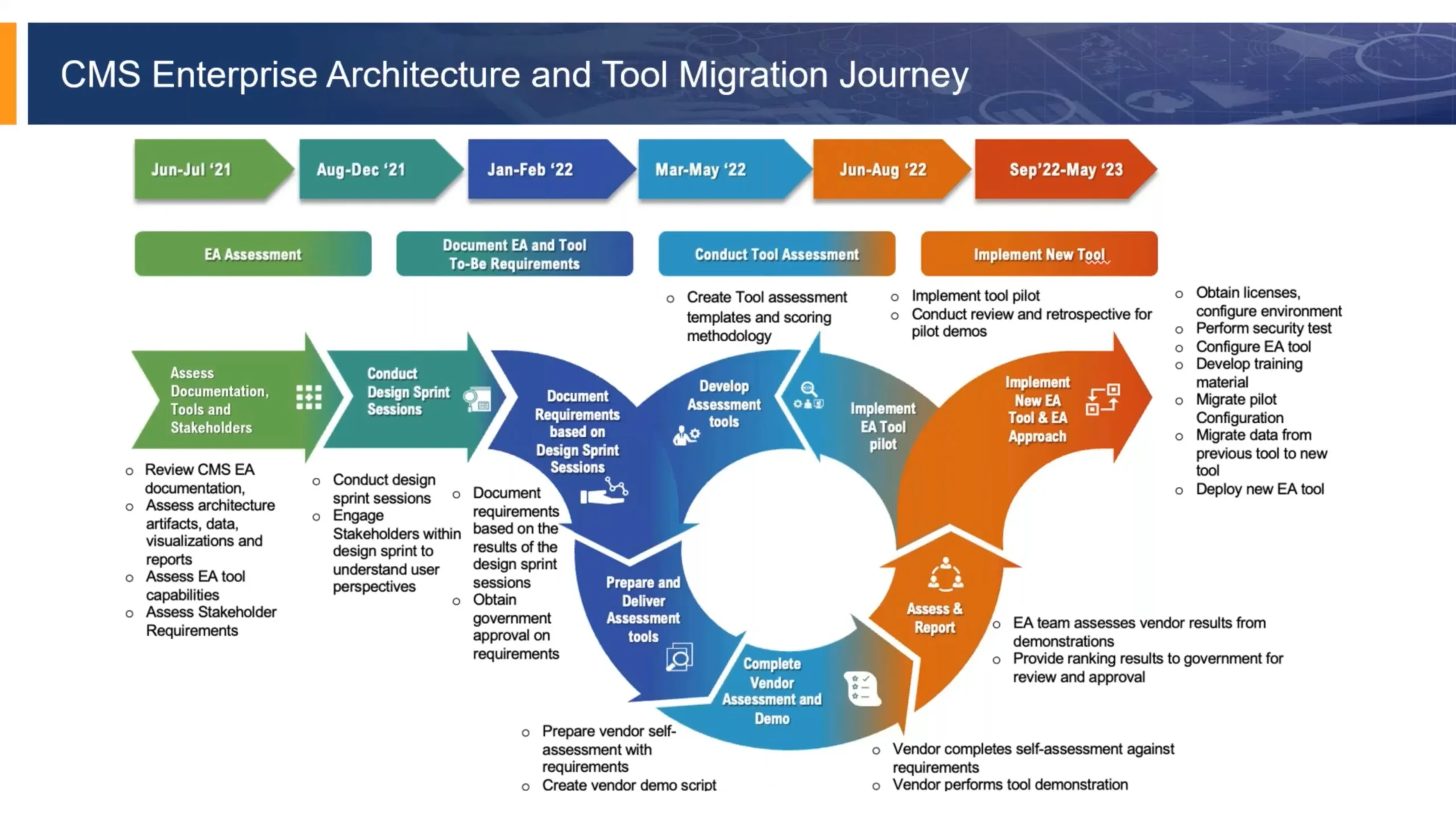
Phase 1: Baseline Assessment (Gaining an Overview)
During this phase, a thorough assessment was carried out of the existing IT architecture, including hardware, software, applications and data sources. The needs and requirements of various stakeholders from different departments within the CMS were identified.
Phase 2: Requirements Definition (Setting the Course)
Design workshops were held to define methodologies, approaches to data visualisation and the desired functionalities of the new architecture platform. Input from stakeholders was crucial in defining specific use cases for Sparx Systems EA.
Phase 3: Tool Evaluation (Selecting the Right Solution)
A comprehensive vendor evaluation was carried out, during which various enterprise architecture tools were assessed against the defined requirements. Sparx Systems EA was selected due to its data-centric approach, out-of-the-box functionality and alignment with the CMS’s requirements.
Phase 4: Implementation (Bringing the Vision to Life)
Sparx Systems EA was successfully implemented in the CMS cloud environment. Initial modelling functions were deployed, enabling the creation of visual representations of the IT infrastructure.
Tool Assessment Approach
A crucial phase in the CMS implementation process was the tool evaluation. This phase ensured that the enterprise architecture (EA) platform best suited to the requirements was selected. The evaluation followed a rigorous approach, which can be divided into four key steps:
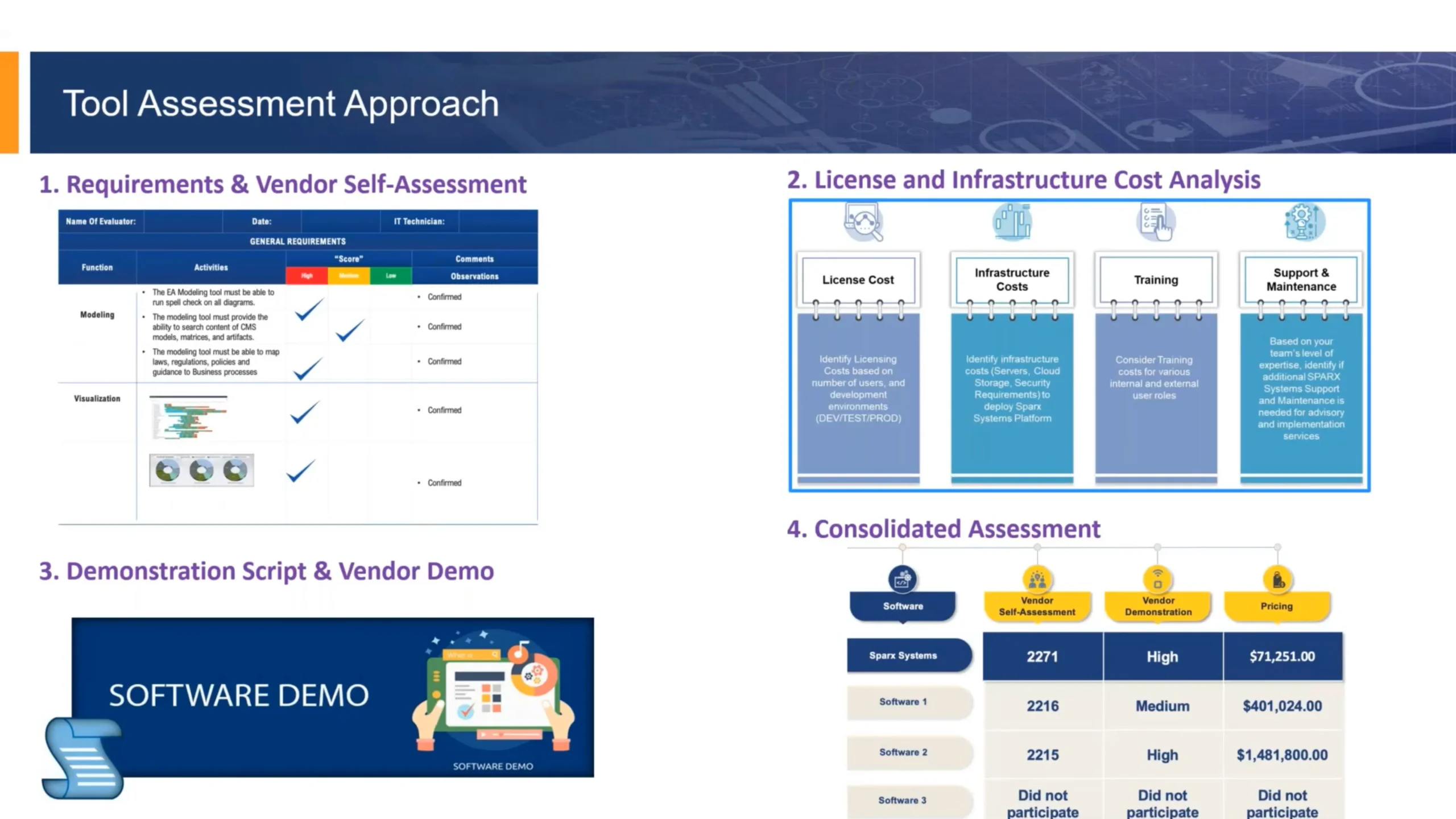
- Requirements and Vendor Self-Assessment:
- CMS meticulously defined its specific requirements for the EA platform. Theserequirements covered functionalities, data management capabilities, integration requirements and scalability considerations.
- Potential suppliers were provided with a detailed self-assessment questionnaire tailored to the requirements defined by CMS. This questionnaire helped CMS to understand the extent to which each supplier’s platform met the organisation’s specific requirements and constraints.
- Analysis of Licensing and Infrastructure Costs:
- Beyond the functionalities, CMS assessed the total cost of ownership for each shortlisted platform. This included an analysis of licence fees, potential infrastructure upgrades required to support the platform, and ongoing maintenance costs.
- Demonstration Script and Vendor Demo:
- Based on the self-assessment and cost analysis, CMS compiled a shortlist of a few providers. These providers were invited to take part in live demonstrations.
- A predefined demonstration script was developed, setting out specific functions and scenarios that each vendor was required to present. This ensured consistency and a fair evaluation of all vendors.
- Summary Evaluation:
- Following the demonstrations, CMS carried out a comprehensive evaluation. This evaluation took into account the providers’ responses from the self-assessment, the analysis of licence and infrastructure costs, and the live demonstrations.
- An evaluation matrix may have been used to assess each provider against predefined criteria, thereby ensuring objectivity and transparency in the selection process.
AWS Deployment for the CMS Sparx Implementation
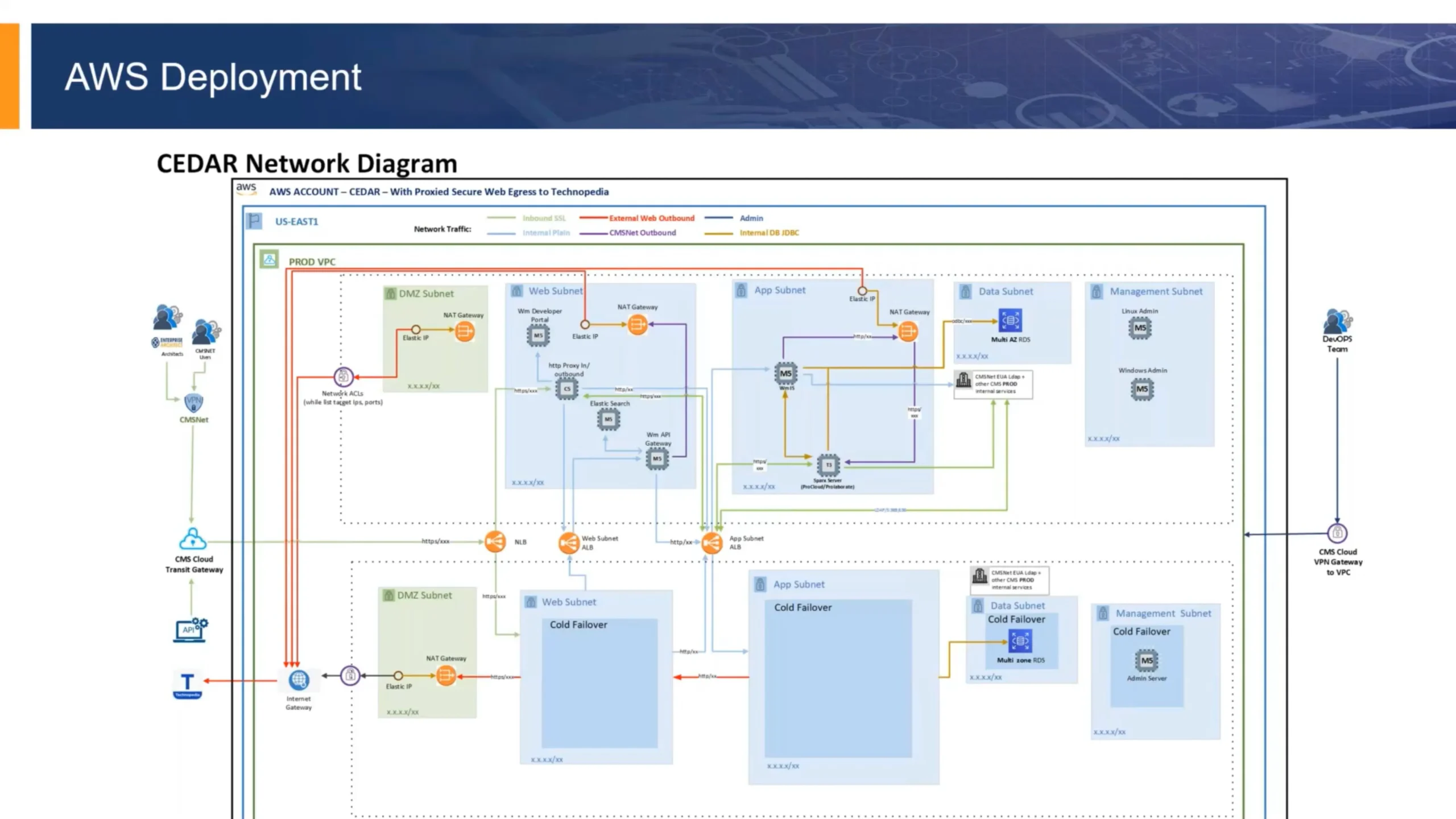
AWS Cloud Environment
The CMS’s AWS presence is organised using a sub-organisation structure, with services provisioned from the main CMS cloud account. This approach ensures consistency and optimises resource management across the organisation.
VPC Architecture
The architecture utilises Virtual Private Clouds (VPCs) with separate subnets for development, testing and production environments. Best practice security procedures are followed, with the data subnet isolated behind the application and web subnets to ensure data integrity and protection.
Availability Zones
Whilst the current deployment is located in a single availability zone, communication mechanisms across other zones are in place to ensure redundancy and high availability. This configuration enhances the resilience of the CMS IT infrastructure.
Single Sign-On (SSO)
CMS offers single sign-on (SSO) functionality via security tokens integrated into the Sparx Systems platform. This integration simplifies user access and enhances security by utilising existing authentication mechanisms.
Implementation Phases
The implementation process involved a joint design phase with the Sparx Systems team, followed by the development, testing and production deployment phases. This structured approach ensured that all aspects of the roll-out were carefully planned and executed.
Security Aspects
Security scans were carried out, during which eight vulnerabilities were identified. Through collaboration with the Sparx Systems team, six vulnerabilities were rectified within 30 days, meaning that a formal Memorandum of Understanding (MOU) was not required. The remaining two vulnerabilities were rectified prior to final deployment, thereby ensuring a secure and compliant environment.
Compliance
The deployment complies with Section 508 accessibility standards. A test plan was developed in collaboration with the Sparx Systems team, achieving a score of 75.13 per cent. Efforts are continuing to improve this score and to secure an exemption for the ‘Sparx EA Future Client’ application due to its visualisation nature.
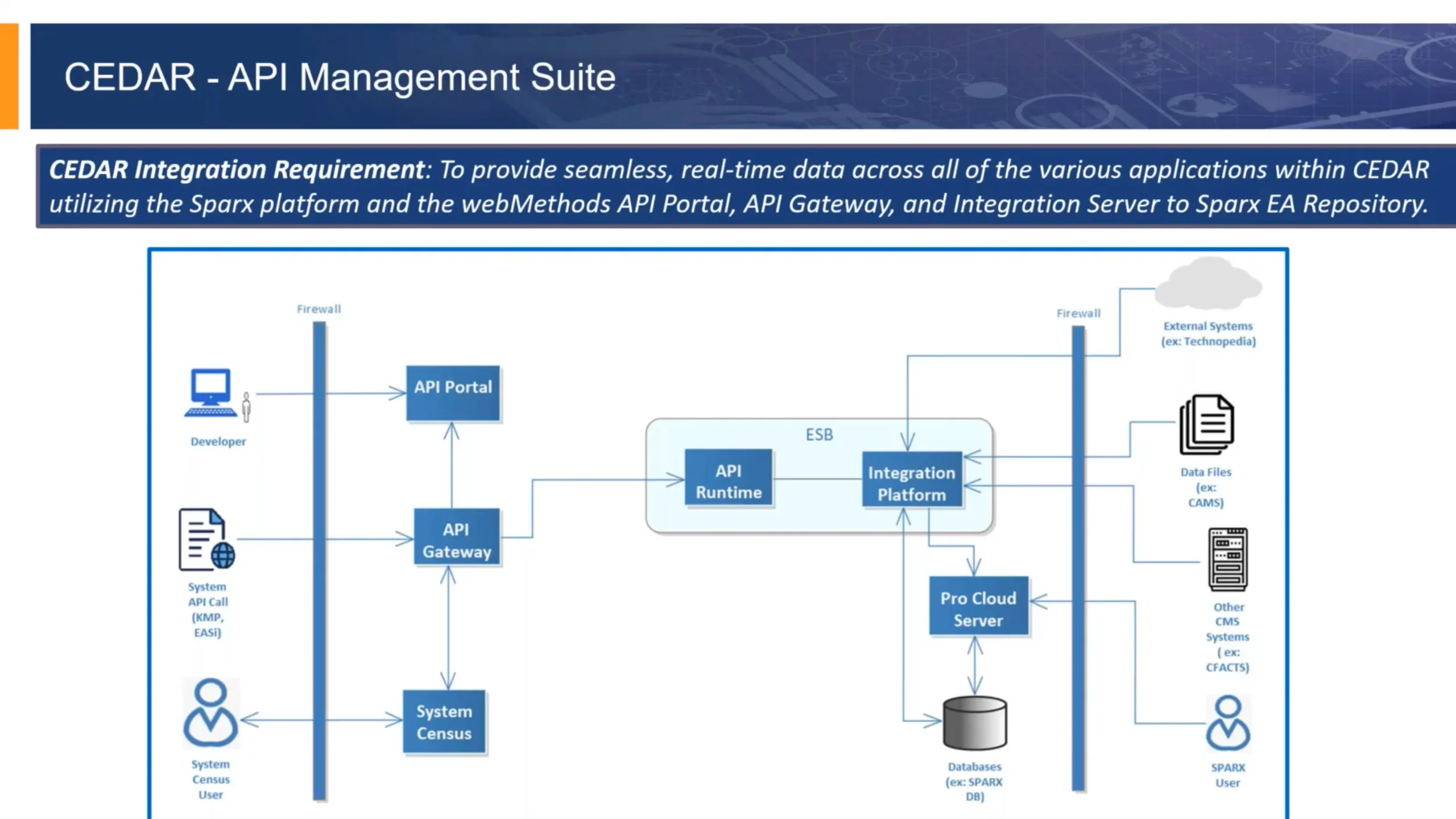
API Portal
The API Portal provides external developers with access to information about the APIs published by CMS. Through this portal, developers can:
- find out about available APIs,
- view input and output signatures,
- read detailed descriptions and usage guidelines.
This facilitates external collaboration and integration by providing comprehensive information on CMS’s APIs.
API-Gateway
The API Gateway is the primary entry point for all incoming API calls. It fulfils several key functions:
- Authentication and authorisation: Ensures that only authorised users can access the APIs.
- Enforcement of security policies: Applies and enforces security measures to protect data.
- Monitoring and logging: Tracks API usage and performance.
- Analytics: Provides insights into API usage patterns.
- Throttling and monitoring of denial-of-service attacks: Protects the system from overloads and attacks.
Acting as a ‘gatekeeper’, the API gateway ensures the secure and efficient management of API traffic.
Enterprise Service Bus (ESB)
The ESB consists of the API runtime environment and the integration platform:
- API runtime environment: This is where REST API code is deployed and executed.
- Integration platform: Supports various methods of data collection (e.g. REST, SOAP, FTP) and includes tools for data transformation and database connectivity. This platform enables rapid API development and integration, allowing the CMS to efficiently manage and process data from various sources.
API Approach
Abstraction of Complexity for Developers
As CMS API developers are not regular users of the Sparx Systems EA system, a strategy was developed to abstract the system’s complexity. This involved a combination of the Sparx Systems EA API, stored database procedures and database views. Key elements of this approach include:
- Wrapper APIs: Simplifying interactions by handling authentication, token requests, data formatting, execution and validation of responses.
- Stored procedures: Facilitate updates through meaningful names and clear data requirements, allowing developers without in-depth system knowledge to focus on their tasks.
- Database views: Provide intuitive access to data and make it easier for developers to find and retrieve the information they need.
This approach boosts productivity and enables developers to focus on their core competencies, thereby significantly reducing onboarding time and development time.
About SparxSystems Europe
Sparx Systems Pty Ltd (Australia) was founded in 1996 and is the manufacturer of Enterprise Architect, a globally successful UML modeling platform. Enterprise Architect is used for designing and building software systems, business process modeling and modeling any process or system. Enterprise Architect is valued by over 1 million users for its performance at an unbeatable price. Enterprise Architect is an easy-to-understand, team-oriented modeling environment that helps companies analyze, design and build systems that are accurately understood and documented. With the help of this tool, companies are enabled to collect and present the often very dispersed knowledge of teams and departments centrally.
SparxSystems Software Europe was set up in 2004 to provide the best possible Enterprise Architect service to the many customers in their language and time zone, supporting the entire German-speaking region with license acquisition, training and consulting. SparxSystems Software Europe is a business unit of the Lieber.Group.